An on-grid solar system saves money on electricity bills, but it has one big drawback: it shuts down the moment the power goes out. Your panels sit idle on the roof while your house depends on a small inverter battery.
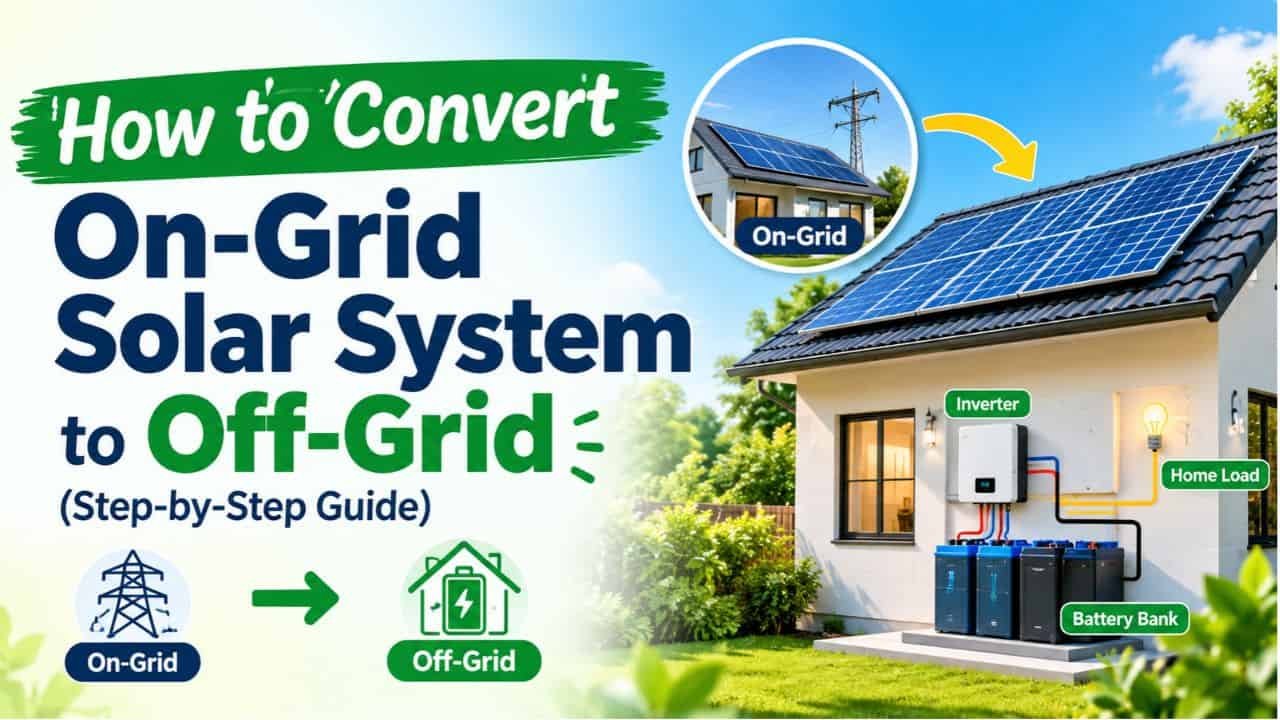
The good news is that you can fix this without buying an expensive hybrid inverter. In this guide, we explain how to convert an on-grid solar system to off-grid using a high-VOC solar charge controller with an automatic grid-switching feature.
Why an On-Grid Solar System Stops During a Power Cut
A grid-tie inverter needs the grid’s voltage as a reference to work. When the grid goes down, the inverter must shut off. This is a safety rule that protects line workers from back-feed.
As a result, you face two problems:
- Your home load runs only on the inverter battery.
- A 2-battery setup running a 400-500 W load lasts only about 3-4 hours.
- Your solar panels give no benefit during the outage.
Two Ways to Get Solar Power During a Power Cut
| Option | Approx. Cost | Best For |
| Hybrid inverter | Around ₹70,000-75,000 for a 3 kW inverter alone, plus batteries | New installations |
| Solar charge controller between the on-grid system and your existing inverter-battery | Much lower; you reuse your existing inverter and batteries | Homes that already have an on-grid system and an inverter |
If you already have a subsidy-based on-grid system and a working inverter-battery, the second option is far more economical.
What You Need for the Conversion
- An existing on-grid solar system (panels plus grid-tie inverter)
- An existing inverter and battery bank
- A solar charge controller with grid-sensing and auto-switching
- MC4 connectors and properly rated DC cables
The Device That Makes It Possible: Ashapower Cyrus 60 Hybrid Pro
The controller used in this guide is the Ashapower Cyrus 60 Hybrid Pro, a 60 A MPPT solar charge controller. It sits between your on-grid system and your existing inverter-battery.
Key Specifications
| Parameter | Details |
| Rated current | 60 A |
| Battery voltage | 24 V / 36 V / 48 V |
| Max VOC at 24 V | 350 V (supports panels up to 4 kW) |
| Max VOC at 36 V | 450 V (supports panels up to 6 kW) |
| Max panel capacity at 48 V | 6 kW |
| Grid switch-over delay | 17 seconds |
| Switching component | Contactor (not relay) |
| Battery types | Lead-acid, gel, SMF, lithium |
| Warranty | 2 years |
Standout Features
- High VOC input: Supports 8-9 panels in series on the 450 V input.
- Wide battery compatibility: Works with lead-acid, gel, SMF and lithium batteries.
- Auto bypass: It is on by default, and you can change it as needed.
- Built-in cooling fans: They keep the unit cool during operation.
- Lithium support: Newer Ashapower controllers are lithium-compatible. For lithium, contact the company first to configure the settings.
How the Conversion Works
The controller continuously watches the grid supply and switches between two modes.
When the Grid Is Available
Your solar panels keep feeding power through the grid-tie inverter, exactly as before. The controller stays disconnected from the panels.
When the Grid Fails
- The grid-tie system shuts down automatically.
- The controller waits 17 seconds to confirm the grid has not come back.
- It then connects your solar panels to the inverter-battery.
- Solar power charges the battery and runs your home load.
Why the 17-Second Delay Matters
The delay is a safety feature. It prevents the system from switching on a brief grid flicker and ensures a stable transition.
Safety Features Built In
High-voltage DC can cause sparking when switching. This controller reduces that risk in several ways:
- It uses a contactor instead of a relay, which handles high-voltage DC more safely.
- It stops current flow before switching from on-grid to off-grid mode.
- When the grid returns, the MPPT first stops exchanging current with the battery, and only then turns off the relay.
- It uses a high-current DC conductor for protection against extreme or unexpected faults.
How to Convert On-Grid to Off-Grid: Step-by-Step
Step 1: Connect the Battery
Connect the battery wires first. The controller beeps and scans the battery. With two 12 V batteries, it automatically sets itself to 24 V and limits the panel input to 350 V VOC.
Step 2: Check Panel Compatibility
At 350 V VOC, you can connect about five newer 600 W panels in series, or six older panels. Always keep the total VOC of your string within the controller’s limit.
Step 3: Connect the Solar Panels
Connect the panel wires to the MC4 connectors. The display lights up, the fan starts, and battery voltage begins to rise.
Step 4: Connect Grid and Inverter Wires
Under the bottom cover, connect the grid input, the inverter’s negative wire and the battery wire. Follow the wiring diagram provided with the unit, and use a qualified electrician for the on-grid connection.
Step 5: Test the Switching
Cut the grid supply and check that the controller connects the solar panels after about 17 seconds.
Real-World Test Results
The setup was tested with:
- 2 gel batteries (24 V system)
- 6 solar panels of 375 W each
- Display showing solar input of about 1 kW
The results:
- Solar charging started immediately and battery voltage rose.
- When grid supply was connected, solar charging stopped.
- When the grid was cut, the controller reconnected solar power in about 17 seconds.
The tester noted that charging wattage can be higher than the 1 kW seen, since charging current is limited by the battery settings.
Benefits of This Method
- Lower cost: No need to replace your existing inverter or battery.
- Use solar during outages: Panels power your home and charge the battery.
- Longer backup: The battery no longer drains alone.
- Even a 3 kW setup can be connected on just two batteries.
Frequently Asked Questions (FAQs)
1. Can I run my on-grid solar system during a power cut?
Not by itself. A grid-tie inverter shuts down when the grid fails. By adding a controller like the Ashapower Cyrus 60 Hybrid Pro, your panels connect to your inverter-battery about 17 seconds after the outage begins.
2. Do I need to buy a hybrid inverter?
No. A 3 kW hybrid inverter alone can cost ₹70,000-75,000, before batteries. If you already have an inverter-battery, a charge controller is a cheaper alternative.
3. How many solar panels can I connect?
It depends on battery voltage. At 24 V, the limit is 350 V VOC (up to 4 kW). At 36 V it is 450 V VOC (up to 6 kW), and at 48 V it supports up to 6 kW of panels.
4. Can I use lithium batteries with it?
Yes. The controller works with lead-acid, gel, SMF and lithium batteries. For lithium, contact the company first to set the controller’s parameters.
5. Why does it take 17 seconds to switch?
The delay is intentional. It confirms the grid has really failed and is not just flickering, which makes the switch-over safer.