Every time a new solar technology hits the market, it arrives with big claims and a bigger price tag. Today, that technology is HJT, and many sellers pitch it as the best panel ever made.
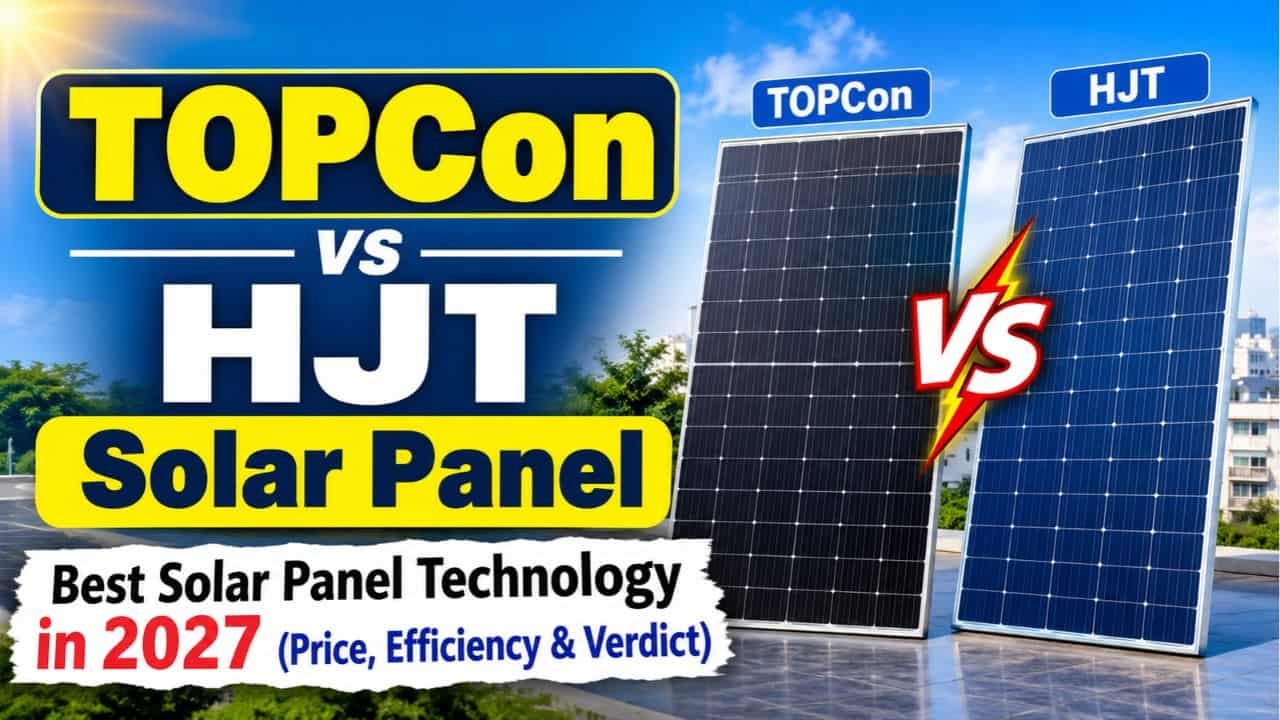
But is it worth the extra money for a home rooftop? This guide compares TOPCon vs HJT on efficiency, price, heat performance, and availability, so you can decide with facts instead of marketing.
Latest Solar Panel Technology: How We Got Here
Solar panels have improved in clear steps over the years.
- Polycrystalline: The older, cheaper option
- Mono PERC: Higher efficiency and the most widely installed type in India
- Half-cut and bifacial: Better shade handling and rear-side power
- N-type TOPCon: The current mainstream upgrade
- HJT (Heterojunction): The premium option, now entering the market
Both TOPCon and HJT use N-type silicon. The difference lies in how each cell collects electricity, and that changes cost and performance.
TOPCon vs HJT at a Glance
| Factor | TOPCon | HJT |
| Typical module efficiency | About 22% to 25% | About 23% to 26% |
| Temperature coefficient | About -0.30% to -0.32% per °C | About -0.24% to -0.26% per °C |
| Annual degradation | About 0.4% | About 0.25% to 0.3% |
| Price | Moderate | Higher |
| Manufacturing in India | Widely available | Limited, just starting |
| Best for | Most homes | Hot climates, premium or utility projects |
Figures vary by brand and model, so always read the datasheet of the exact panel you are quoted.
HJT vs TOPCon Efficiency
HJT is more efficient, but only slightly. In the source video, the installer puts TOPCon at around 23% and HJT at around 24%, a gap of roughly 1 percentage point. Industry executives quoted by trade media have put the gap even lower, at about 0.5%.
The efficiency printed on a panel sticker is a lab-tested figure. Real rooftop output depends on heat, shade, dust, and installation quality. Also, today’s market offers panels around 700 to 750 watts in both technologies, so HJT is not yet delivering larger panels than TOPCon.
For reference, Reliance’s India-made HJT module is listed at up to 23.1% efficiency, which is in the same range as good TOPCon panels.
Temperature and Degradation: Where HJT Does Better
This is HJT’s real strength. Panels lose output as they heat up, and India has plenty of heat.
- TOPCon loses about 0.32% of output per degree above 25°C
- HJT loses about 0.24% per degree above 25°C
- TOPCon degrades about 0.4% per year
- HJT degrades about 0.25% to 0.3% per year
These are real advantages, but they are small. On a summer afternoon at 60°C panel temperature, the gap works out to a few percentage points of output, and over 25 years the difference adds up slowly.
What is the Price Difference Between TOPCon and HJT?
HJT costs more, and the gap is bigger than the performance gap.
| Technology | Price Premium |
| TOPCon over Mono PERC | About 15% to 25% |
| HJT over Mono PERC | About 25% to 40% |
| HJT over TOPCon | Roughly 15% to 19% in trade quotes |
Retail prices across all three technologies in India run from about ₹20 to ₹36 per watt, depending on brand, wattage, and order size. One exhibitor quoted in the video put HJT at around ₹22 per watt, which shows how much quotes can differ.
The reason for the premium is manufacturing. A factory switching from PERC to TOPCon can reuse much of its line. HJT needs a largely new line, with one industry leader estimating that around 80% of the investment is fresh capital. That cost flows into the panel price.
What Are the Disadvantages of TOPCon Solar Panels?
TOPCon is a strong choice, but it is not perfect.
- Higher price than PERC: You pay a premium of about 15% to 25%
- Weaker heat performance than HJT: The temperature coefficient is less favourable
- Slightly faster degradation: About 0.4% per year versus HJT’s lower figure
- Quality varies by brand: Reports of UV-related and moisture-related degradation in some batches have worried the industry, and manufacturers are working on fixes
- Fake and relabelled panels: Because TOPCon is in demand, low-quality products are sold under the name. Read our guide on TOPCon panel scam awareness before buying
None of these is a deal breaker. They are reasons to buy from a reputed brand with a solid warranty.
HJT Solar Panel vs TOPCon Bifacial Solar Panel
Both technologies are available in bifacial form, which means they also generate power from light hitting the rear side. HJT cells generally handle rear-side light a little better, but the bifacial gain also depends on your roof surface, panel height, and spacing.
For homes, a TOPCon bifacial panel is usually the better value. The extra HJT cost is hard to recover on a small rooftop, and a bifacial structure costs more either way.
Who Makes HJT Solar Panels?
HJT production is smaller than TOPCon, but it is growing.
| Maker | Notes |
| Reliance Industries | India’s first company to start GW-scale HJT module production, with panels up to 720W and BIS certification |
| Waaree | Showed an HJT bifacial module for large projects at REI 2024 |
| REC Group | Reliance-owned brand that pioneered HJT modules for homes |
| Huasun and Tongwei | Chinese producers with commercial HJT production |
Note that the installer in the video believed no Indian company was making HJT. That was true for a long time, but it is now changing, as Reliance has started domestic production and had its HJT cells added to the ALMM list. Check the MNRE ALMM list for the latest approved models.
The Real-World Test: More Watts for the Same Money
The video shares a useful example for a roughly 2 lakh rupee budget.
| Option | Panels | Total Power |
| TOPCon, 615W | 16 panels | About 9.8 kW |
| Mono PERC bifacial, 545W | 22 panels | About 12 kW |
For similar money, the PERC bifacial system gives more capacity and more yearly generation. The trade-offs are a larger roof area and a slightly costlier structure for bifacial panels. If you have the space, more watts usually beat a small efficiency edge.
Which Panel Should You Buy?
- Choose TOPCon if you want modern technology at a sensible price. It suits most homes
- Choose Mono PERC bifacial if you have plenty of roof space and want maximum generation per rupee
- Choose HJT if you live in a very hot area, have limited roof space, or simply want the newest technology and accept the premium
For megawatt-scale projects, even a 1% efficiency gain matters. For a 3kW to 10kW home system, it rarely does.
If you want to compare actual brands, read our Adani vs Waaree solar panel comparison. To understand subsidy rules, see our guide on solar panel for home government subsidy.
Frequently Asked Questions
Is HJT better than TOPCon for Indian homes? HJT performs slightly better in heat, but the gain is small, and the price is higher. For most rooftops, TOPCon offers better value.
Do HJT panels qualify for the PM Surya Ghar subsidy? Subsidy requires DCR panels with Indian-made cells. Ask for the DCR certificate and confirm the exact model with your installer before paying.
Will HJT prices fall in the future? They may, as Indian production grows. But TOPCon is also improving, and its efficiency gains have narrowed the gap, so the price advantage of TOPCon may remain.
Is the efficiency on the panel sticker what I will actually get? No. Sticker efficiency is measured in a lab. Real output depends on temperature, shade, dust, and installation.
Should I wait for HJT before installing solar? Not necessarily. Waiting costs you months of electricity savings, and the performance gain from HJT on a home system is small.